Annex 1.
Technical Background
The Seas of East Asia1
The seas of East Asia are defined as the Yellow Sea, the East China Sea, the South China Sea,
the Gulf of Thailand, the Sulu-Celebes (Sulawesi) Sea, and the Indonesian Seas six large
marine ecosystems (LMEs) that are inter-connected by natural processes, ocean currents, and
shared living marine resources. The aquatic ecosystems and sources of land-based pollution
affecting each regional sea included in this project are described below.
Figure 1: map of East Asia showing land masses and water bodies. Source: PEMSEA
The Yellow Sea, including the Bohai Sea, has a geographically unique floor and complex biotic
communities due to the complicated oceanographic conditions of the area. It is a semi-enclosed
body of water, connected with the East China Sea to the south. It receives large amounts of
sediment, mainly from the Yellow River in the north, and from the Yangtze River in the south.
Pollution in the Yellow Sea originates from land, sea, and air-based sources, and includes
organic matter, petroleum, metals, and inorganic nitrogen. Major pollutants come from
industrial wastewater, domestic sewage, and agriculture.
1 Technical data in this section from www.giwa.net (UNEP / GEF / KALMAR-funded Global International Waters Assessment
reports) and from PEMSEA assessments.
Page 24
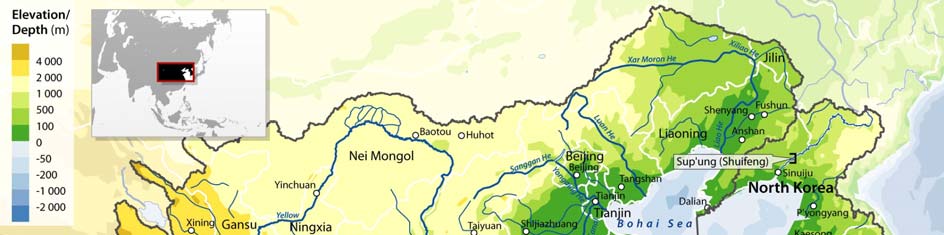
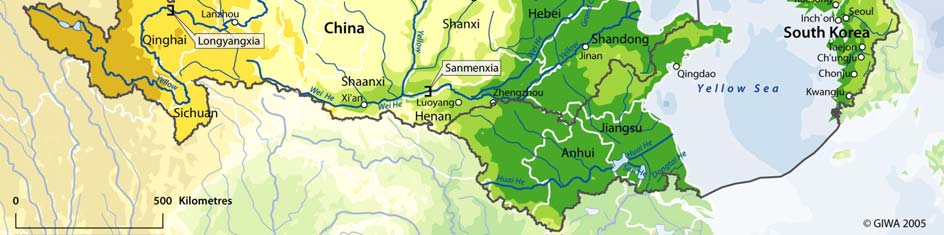
The most serious source of pollution originates from domestic, industrial and agricultural
pollution discharges into the rivers that discharge to the Yellow Sea. For example, each year
about 200 million tonnes of domestic sewage flows into the Yellow Sea via the Yellow and Liao
Rivers. Agricultural and industrial pollution are also a problem, leading to increased
concentrations of metals, pesticides, and oil in marine organisms. Dumping of solid waste
(garbage, fishing gear) has increased in the region, causing public concern for recreational
activities and tourism.
In the Bohai Sea, whose land basin is home to 35% of China's population, microbial pollution in
seafood, although still frequent, is decreasing, partly owing to the construction of wastewater
treatment facilities in large cities. However, harmful algal blooms are frequent (5 6 times per
year) and eutrophication is considered severe. Large-scale use of pesticides and insecticides in
agriculture and metals from industry has resulted in chemical pollution, with negative impacts on
biodiversity. Solid waste has frequently been reported, which has been significant enough to
deter the public from recreational activities on the beach around the Bohai Sea.
Figure 2: Yellow Sea and Bohai Sea. Source: GIWA.net
The East China Sea is important for its spawning and nursery grounds for many pelagic fish. It
is bordered to the west by China, to the east by the Kuroshio Current, to the north by the Yellow
Sea, and to the south by the South China Sea. It receives a large freshwater input and terrigenous
sediment load from the Yangtze River. Microbial pollution is present in the sea, and harmful
algal blooms have been regularly detected.
The treatment capacity for domestic sewage in China's coastal cities is only approximately 60%
while the rate of sanitary disposal of household refuse is between 70 90%. Both of these
sources of pollution have been found to cause bacterial water pollution. Since the 1980s the use
of chemical fertilizers in agriculture has greatly increased, causing ubiquitous eutrophication.
Page 25



The main pollutants carried to the sea by adjoining rivers are COD, nutrients, petroleum
hydrocarbons, and heavy metals.
In 1999, the total discharge of wastewater from Shanghai Municipality, amd Zhejiang and Fujian
Provinces was 5 billion tonnes, of which 2.8 billion tonnes discharged directly into the East
China Sea. Moreover, the dumping of solid waste has been on the increase; in 1999, the total
domestic waste load in Shanghai reached 5 million tonnes, of which only 85% was disposed of
in sanitary landfills. Industrial solid waste reached 156 million tonnes in 2000, although the
percentage of this waste that reached the ocean is unknown.
Figure 3: East China Sea. Source: GIWA.net
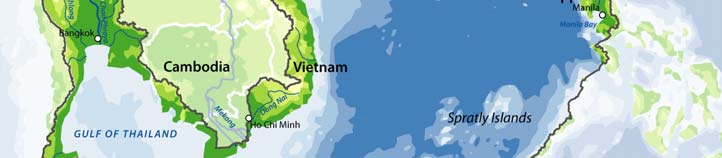
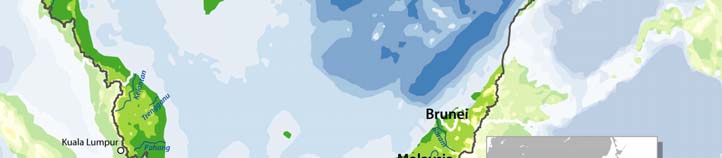
The South China Sea, including the Gulf of Thailand, is known as the global center of marine
shallow-water tropical biodiversity: one-fourth of the world's coral reefs occur in this region,
mangroves are found in great abundance (over 54,000 km2, or 40 % of the global mangrove
area), and seagrass, which is economically important to fisheries and ecologically important to
other species, is highly diverse and well represented in the area. The South China Sea is
bounded to the east by the Sulu-Celebes Sea and Pacific Islands, to the south by the Indonesian
Seas, to the north by the East China Sea, and to the west by the Mekong River.
The health of the South China Sea is in serious decline due mainly to coastal development: the
area's rapid economic development and population growth are the cause of significant ecological
damage. One of the primary environmental threats is sewage pollution, which affects
biodiversity and fisheries, and has health impacts on downstream populations. Pollution,
overfishing and destructive fishing practices are threatening 80% of the coral reefs in the region,
and endangering seagrass habitats. In much of the region, sewage treatment is superficial at best,
with raw or primary treated sewage discharged directly into water courses. Agricultural
Page 26
pollution is also widespread through leaching of fertilizers and pesticides into watercourses.
Pollution of Ha Long Bay (Vietnam) threatens coral reefs, marine life, and the livelihood of
hoteliers and fishermen. In 10 years, 900 million tonnes of sediment polluted by coal mining
have been transported by rivers into the Bay, and close to 9 million m3 of industrial wastewater
contaminated by lead and petrol is discharged into the Bay every year. In Indonesia, municipal
and industrial wastewater is discharged virtually untreated into the waterways causing rapid
deterioration in the quality of river water. Eutrophication hotspots occur in the vicinity of coastal
cities and estuarine areas in non-urban settings where sewage or industrial discharges are directly
dumped because of the lack of sewer connections to centralized sewage treatment facilities. This
is commonplace in Indonesia, Vietnam, and the Philippines. Finally, solid waste (garbage, litter
on beaches) has given rise to public concern regarding recreational use and tourism.
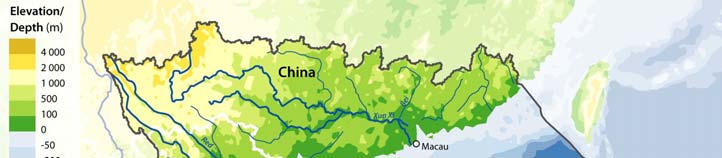
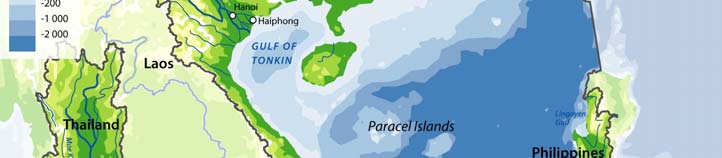
Figure 4: South China Sea. Source: GIWA.net
The Sulu-Celebes (Sulawesi) Sea area is one of the world's most biologically diverse marine
environments. It lies within the global centre of biodiversity for both terrestrial and marine
species with, for example, more than 400 species of reef-building corals, and 2,500 species of
marine fishes. It contains most of the Philippines islands (excluding the northern islands), the
Page 27
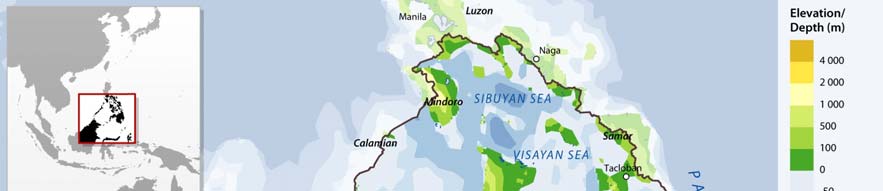
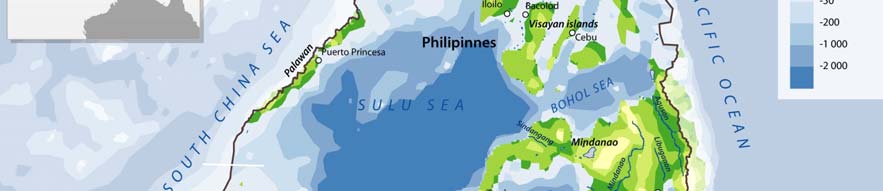
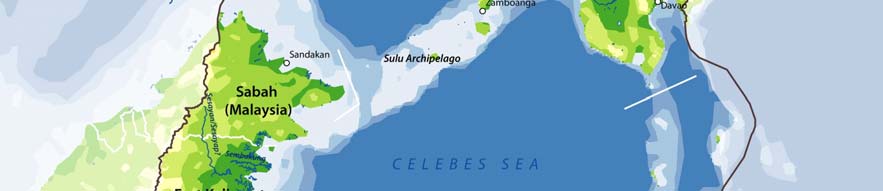
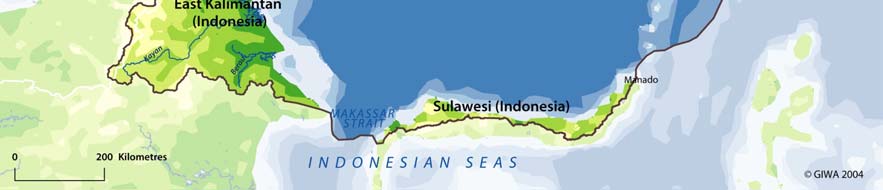
northernmost islands of Indonesia, and Malaysian Sabah. In the major urban centers, sewage
treatment is superficial at best, with raw sewage discharged directly into water courses.
Agricultural pollution is also widespread through leaching of fertilizers and pesticides.
Microbial pollution is significant in major urban centers, originating from inadequate sewage
disposal and treatment, which has affected fisheries and human health. The production of
wastewater in the Manila region is estimated at 74 million m3 in 1994, while the volume of
treated wastewater reached just 10 million m3. Eutrophication, although localized, has caused
some paralytic shellfish poisoning in parts of the region. Solid waste has caused moderate
environmental impact in the region. However, there has been severe impact locally, particularly
around the larger cities, where waste management is either poor or non-existent. There is
widespread litter on beaches, high frequencies of benthic solid waste recovery by trawlers, and
frequent reports of entanglement / suffocation of marine species by solid waste.
Figure 5: Sulu-Celebes (Sulawesi) seas. Source: GIWA.net
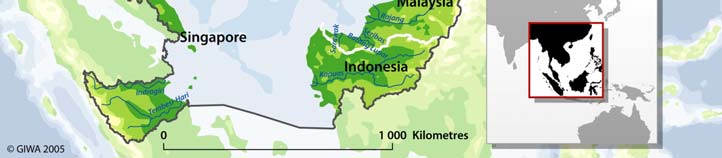
Finally, the Indonesian Seas are important because they support an extremely high biological
diversity, including both demersal and pelagic fisheries, sharing highly migratory fish resources
(tuna, mackerel, round scad) with adjacent countries. The Indonesian Seas encompass most of
the 18,000 islands of the republic of Indonesia, bounded on their western and northern extent by
Page 28
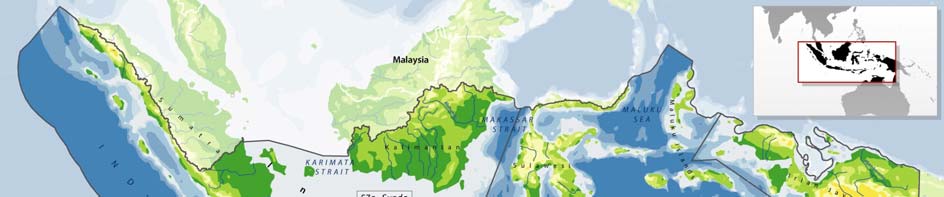
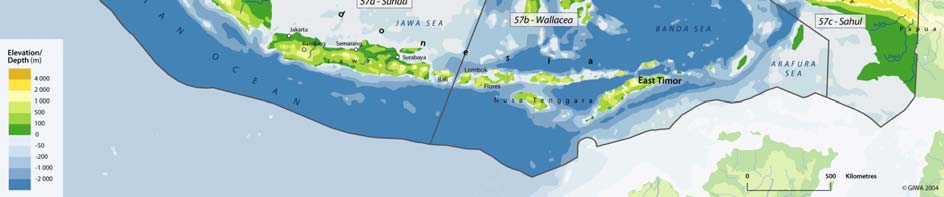
the Bay of Bengal, South China Sea, and Sulu-Celebes (Sulawesi) Seas; on their southern extent
by the north Australian shelf; and northeastern extent by Pacific islands.
Urban expansion and industrialization have resulted in water pollution from industry, sewage,
and contaminated air. Municipal and industrial wastewater is discharged virtually untreated into
the waterways causing rapid deterioration of water quality, particularly in the large urban centers
(e.g. Jakarta, Surabaya). Total discharges of organic water pollution have experienced a rapid
increase from 214 tonnes per day in 1980 to over 537 tonnes per day in 1993. Toxic algal
blooms have caused paralytic shellfish poisoning, and shellfish from most of the Java Sea are no
longer eaten. Eutrophication has severe local impacts e.g. in the Jakarta Bay, where massive
blooms of phytoplankton several meters thick are present for several kilometers offshore.
Overall, solid waste poses a severe problem, particularly in the Java Sea and around cities where
waste management is unable to keep pace with production. Massive amounts of plastic bags and
other waste products flow into Jakarta Bay and foul the Pulau Seribu islands; plastic and other
floating wastes wash ashore on many beaches and clog outboard motors of boats.
Figure 6: Indonesian Seas. Source: GIWA.net
Page 29
Annex 2.
Strategic Partnership Resolution (provided by PEMSEA)
RESOLUTION
IN SUPPORT OF THE STRATEGIC PARTNERSHIP FOR SUSTAINABLE
DEVELOPMENT OF THE LMEs OF THE SEAS OF EAST ASIA
GEF/UNDP/IMO Regional Programme on Building Partnerships in Environmental Management
for the Seas of East Asia (PEMSEA)
The countries of the East Asian Seas Region have agreed to implement the Sustainable
Development Strategy for the Seas of East Asia (SDS-SEA), with signature of the Putrajaya
Declaration during the Ministerial Forum in Putrajaya, Malaysia, on 12 December 2003. The
Ministerial Forum recognized that the SDS-SEA represents a new paradigm for regional
cooperation, providing an overarching framework and platform for addressing transboundary
issues affecting sustainable development of the large marine ecosystems of East Asia. The
ministers also recognized that a long term stakeholder partnership arrangement is the effective
mechanism to foster and sustain the implementation of the SDS-SEA.
Following the Putrajaya Declaration, efforts to forge strategic partnerships for the SDS-
SEA implementation have been initiated through the joint efforts of GEF, UNDP, World Bank
(WB) and PEMSEA. The Strategic Partnership is intended to promote and formalize operating
partnership arrangements amongst concerned stakeholders, including governments, international
organizations, donors, private sector and other entities from all sectors of society from within and
outside of the East Asian region, to individually and collectively implement action plans
contained in the SDS-SEA.
The outcome of these early efforts is an initial Strategic Partnership arrangement
involving PEMSEA participating countries, GEF, UNDP, and WB to undertake two related and
mutually supportive projects, namely:
(a) GEF/UNDP/PEMSEA project on the Implementation of the Sustainable
Development Strategy for the Seas of East Asia. This project focuses on
facilitating the implementation of the SDS-SEA through mobilization of the
necessary partnership arrangements and operating mechanisms, intellectual
capital, support services and resources for achieving a shared vision of sustainable
use of coastal and marine resources of the region and related targets identified in
the WSSD Plan of Implementation. This will be achieved by assisting the
countries to develop coastal and ocean policy reforms, scaling up integrated
coastal management (ICM) programme implementation, adopting ecosystem-
based management of coastal seas and their watersheds, mobilizing diversified
human and financial resources especially through the promotion of environmental
investments, and strengthening the information gathering and dissemination base
among partners in order to enhance the participation of an informed public; and
Page 30
(b)
World Bank/GEF Partnership Investment Fund for Pollution Reduction in the
Large Marine Ecosystems of East Asia. The WB/GEF project is designed to
enhance public and private sector investment in innovative and cost-effective
technical, institutional and financial mechanisms for pollution reduction within
the LMEs of East Asia. The Partnership Investment Fund would: i) provide grants
to eligible projects that are able to demonstrate innovative technical, institutional
or financial mechanisms to combat land-based water pollution; and ii) support a
Project Preparation Revolving Fund for the purpose of assisting small cities and
peri-urban communities to gain access to financing sources for pollution reduction
facilities and services. The grant and revolving fund mechanisms would focus on
projects that have a high likelihood of replicability and scalability in a specific
country or across the region. Overall, the Partnership Investment Fund would
serve to leverage investments by national and local governments, international
financial institutions, commercial banks, and other private sector groups,
contributing to SDS-SEA objectives covering land-based pollution prevention and
reduction in the LMEs of East Asia.
In view of the above, the PEMSEA Programme Steering Committee at its 11th Meeting
endorses the Strategic Partnership approach to achieve a synergistic, multiplier and cumulative
effect of partnership programmes and projects, as well as any other efforts that contribute to the
shared vision of the SDS-SEA, as contained in the document "Strategic Partnership for
Sustainable Development of LMEs of the Seas of East Asia (PSC/05/DOC/12), and therefore
declares its unanimous support to:
The GEF/UNDP/PEMSEA Project on the Implementation of the SDS-SEA as
embodied in the approved Project Pipeline Concept; and
The World Bank/GEF Partnership Investment Fund for Pollution Reduction in the
Large Marine Ecosystems of East Asia, as embodied in the World Bank paper,
Attachment 2 of PSC/05/DOC/12.
The participating governments agree to do their utmost in facilitating the application of
the Strategic Partnership concept and approach at all levels in project development and
implementation for the purpose of the SDS-SEA.
The participating governments also request the PEMSEA Regional Programme Office to
strengthen its collaboration with the GEF, UNDP, the World Bank and other concerned partners
and stakeholders in the formulation and implementation of the WB/GEF Partnership Investment
Fund, and all future Strategic Partnership programmes and projects for the implementation of the
SDS-SEA.
Unanimously approved by the 11th Programme Steering Committee of the
GEF/UNDP/IMO Regional Programme on Building Partnerships in Environmental
Management for the Seas of East Asia, on the 3rd of August 2005, in Siem Reap,
Cambodia.
Page 31
Annex 3.
Logical Framework
To contribute to the Strategic Partnership's overall goal of catalyzing the sustainable
development of large marine ecosystems of East Asia, the objective of the proposed WB/GEF
Partnership Investment Fund for Pollution Reduction in the Large Marine Ecosystems of East
Asia is to reduce pollution discharges that have an impact on the seas of East Asia by leveraging
investments in pollution reduction through the removal of technical, institutional, and financial
barriers. Expected outcomes of the Fund would be increased investment in activities that reduce
land-based pollution and the replication of cost-effective pollution reduction technologies and
techniques demonstrated by the Fund.
To measure progress in achieving the Fund's targets, quantitative and qualitative indicators
would be used. These include, but are not limited to, reduction in the discharge of BOD, P and
N, the level of replication of pollution-reducing sub-projects, the degree of awareness of
environmental issues (e.g. as measured by the number of visitors to environmental centers, the
amount of coverage of environmental issues by the press), and the amount of financing and rate
of disbursement secured for replicated environmental projects.
A detailed set of monitoring and evaluation criteria have been prepared for the Fund in the World
Bank logical framework format (refer below). It is intended that the use of this format would
facilitate the adoption of the relevant criteria by each sub-project, thereby providing a consistent
approach to monitoring the outcomes of the Fund. Sub-projects would be encouraged to develop
additional criteria where necessary to address any additional local monitoring needs.
Table 1: Indicators at the level of the Fund
Objective of Fund
Outcome Indicators
Use of Outcome Information
To leverage investments in
Increased investment in
Facilitate pollution reduction for
pollution reduction
technological, technical,
all stakeholders
and institutional
mechanisms
To reduce pollution
Key parameters to be
Evaluate progress towards the
discharge that has an impact finalized with Strategic
Fund's contribution to Strategic
on the seas of East Asia
Partnership; are expected
Partnership objectives and country
to include BOD, N and P
progress in meeting agreements
under Strategic Partnership
Page
32
Intermediate results
Results Indicator
Use of Results Monitoring
Result One
To remove technological,
Feasibility and cost-
Facilitate pollution reduction for
technical, and institutional
effectiveness of new
all stakeholders
barriers to pollution
technology and techniques
reduction
proven through
demonstration
Regulatory reform
introduced and planning
capacity strengthened
Governance enhanced
through institutional
strengthening and
improved organization
Result Two
Result Indicator
Use of Result Indicator
To attract financing in a
Increase in sustainable
Broader access to funding for
sustainable and cost
cost-effective financing for environmental infrastructure
effective manner (e.g.
environmental
through revolving funds) for infrastructure in coastal
environmental infrastructure urban areas in East Asia
in coastal urban areas in
East Asia
The leveraging capacity
and turnover ratio of
financial mechanism /
revolving fund are
increased.
N° of countries / lending
institutions that have
adopted the revolving fund
has increased
Result Three
Result Indicator
Use of Result Indicator
Replication / adoption of
Increase in the number of
Wider accessibility to innovative
new pilot technologies,
technologies/techniques
technology
techniques, and institutional tested / successfully piloted
mechanisms
Increased number of
technologies / techniques
replicated throughout East
Asian LMEs
Page
33
Result Four
Result Indicator
Use of Result Indicator
Dissemination activities to
Dissemination of
To raise awareness in the region
share best practices and
information measured
on:
lessons learnt from piloting
through an increase in:
of new technologies /
pollution issues
techniques / institutional
The number of workshops
mechanisms
successful innovations
The number of participants
at workshops
The number of information
documents on GEF's
International Waters web
resource IW:LEARN
The number of times
documents at IW:LEARN
accessed online
The number of participants
at the tri-annual East Asian
Congress organized by the
Strategic Partnership.
Source: modified from Monitoring the Strategy, SDS-SEA (pemsea.org)
Monitoring and evaluation of the activities and investments carried out under the Fund would
also be conducted against the set of indicators embedded in the SDS-SEA, taking into
consideration the sub-set of objectives of the SDS-SEA that are also the underlying objectives of
the Investment Fund.
Table 2: Indicators at the Local Level
SDS-SEA Objective 10
Outcome Indicators
Use of Outcome Information
Coastal urban population
Increase in the percentage
with sewage treatment
of coastal urban population
facilities
with treatment facilities
SDS-SEA Objective 11
Outcome Indicators
Use of Outcome Information
Coastal urban population
Increase in the percentage
serviced with waste
of population with waste
collection and licensed
collection service
disposal facilities
Source: modified from Monitoring the Strategy, SDS-SEA (pemsea.org)
Page
34
Arrangements for results monitoring at the level of the Fund
Target indicators
Project reporting to Fund
Fund reporting to GEF
Responsibi
Frequency
Frequency and
Data Collection
Responsibility for
lity for
Outcome Indicators
2010
2015
and
Reports
Instruments
Data Collection
Data
Reports
Collection
Annual project
Project
PMO project
350
800
progress report
Management
Increased investment in pollution reduction
implementation
to
to
(PPR) and Bank
Office
($ million)
records, Bank
500
1,500
disbursement
(PMO); Bank task
disbursement data
reports
team
Measurements by
Reduction in discharge of BOD to seas of
project implementing
PMO; Bank task
150,000 300,000 Annual
PPR
East Asia (tonnes/yr)
units, government
team
statistics
Result Indicators
Removal of barriers to pollution reduction:
Number of cost-effective technologies/
Commissioning
PMO; Bank task
techniques demonstrated in specific
5 12
Annual
PPR reports on
team
country contexts
investments
Report
Fund Mgmt
annually to
Number of institutional and/or
Register of
Government
Team with
GEFSEC;
regulatory reforms approved and
4 10
Annual
PPR government
agencies, PMO,
data
Report to
implemented
regulations/decrees
Bank task team
derived
GEF
Financing through revolving funds:
from World
Council at
Bank
Number of countries that have
time of
1 4
PMO project
project task
established a revolving fund
PMO; Bank task
request for
Annual PPR
implementation
team
Minimum amount of capital invested in
team
subsequent
15 60
records
reporting
revolving funds ($ million)
tranche
Dissemination and replication of demonstrated technologies, techniques and mechanisms:
Products: Number of publications
6
12
Products: Number of project websites
6
12
PMO project
PMO; Bank task
Events: Number of country workshops
6
12
Annual PPR
implementation
team
Events: Number of regional
records
2 5
conferences/workshops participated in
Mainstreaming of SDS-SEA in World Bank EAP operations:
Number of Strategic Partnership Council
meetings participated in by World Bank
2 2
staff (events/year)
N/A N/A N/A
Number of World Bank CAS which
3 5
include Fund
Page
32
Annex 4.
Sub-project concepts:
Manila Third Sewerage Project
Deleted: <#>Ningbo Water and
Vietnam Coastal Cities Project
Environment Project
Page
32